
Persistent pooling, soggy turf, and basement moisture are frequent frustrations for Capital Region homeowners. If you are struggling with backyard drainage Schenectady NY properties often require more than just a quick surface ditch or a generic downspout extension. Between dense, compacted clay soils and the severe freeze-thaw cycles typical of Upstate New York, water that cannot escape will quickly undermine foundations, drown lawns, and render outdoor living spaces unusable for months at a time.
Whether you own a mid-century ranch in Rotterdam or an older property closer to the heart of Schenectady, managing stormwater requires an integrated approach. By combining targeted earthwork, strategic grading, and engineered hardscape features, you can redirect excess moisture away from your foundation and transform muddy dead zones into durable, functional outdoor living spaces.
Why Backyard Drainage in Schenectady, NY Is Such a Persistent Challenge
To fix standing water permanently, you first have to understand why water collects where it does. Across Schenectady County and surrounding communities like Glenville and Ballston Lake, several site-specific factors converge to create severe runoff headaches:
- Dense Glacial Clay: Much of the soil in Schenectady and Rotterdam consists of heavy clay deposits leftover from ancient glacial lake beds. Clay absorbs water slowly and drains poorly, causing precipitation from spring storms and snowmelt to sit on top of the lawn rather than infiltrating down into the subsoil.
- Flat Neighborhood Topography: Many post-war subdivisions throughout Rotterdam were developed on relatively flat parcels. Without sufficient natural slope to guide water toward municipal storm systems, runoff sits stagnant in shallow hollows between property lines.
- Downspout Overload: Roofs collect thousands of gallons of water during a single heavy storm. When downspouts dump directly adjacent to foundation walls without adequate slope or piping, basements inevitably suffer from hydrostatic pressure and seepage.
- Frost Heave Dynamics: Water trapped in the top twelve inches of soil expands when temperatures drop below freezing. This seasonal upheaval damages concrete slabs, tilts fences, and alters yard grades over time, creating new depressions where water collects year after year.
Evaluating Rotterdam Yard Drainage and Common Property Symptoms
When assessing Rotterdam yard drainage issues, homeowners typically report a familiar pattern: lawns that remain spongy well into June, patches of moss crowding out turfgrass, and patios that hold standing water after brief downpours. Leaving these symptoms unaddressed does not just ruin lawn care routines—it compromises the structural integrity of walkways, driveways, and home foundations.
Drainage failures often show up in distinct ways:
- Foundation Perimeter Pooling: Water collecting against the exterior foundation wall indicates negative grading, where the surrounding ground slopes toward the house rather than away from it.
- Surface Sheet Flow from Uphill Neighbors: If your property sits lower than an adjoining lot, unmanaged surface runoff can wash through your gardens and swamp your lawn during intense rain.
- Paved Surface Settling: Patios and walkways that were installed over poorly drained, uncompacted sub-bases develop low spots where puddles linger, eventually cracking pavers as freeze-thaw shifts the ground underneath.
How Hardscaping and Grading Work Together as Drainage Solutions
True drainage corrections rarely rely on a single pipe. Instead, the most enduring fixes blend hardscaping installations with structural earthwork, giving water a planned, controlled route off your property.
1. Corrective Yard Grading
Grading is the baseline of any stormwater management plan. Effective grading ensures that the soil falls away from your home’s foundation at a minimum slope of one quarter-inch per foot for the first ten feet. By recontouring high ridges and filling nuisance depressions, grading channels surface runoff toward safe release points, such as swales, rain gardens, or catch basins, before water ever has the chance to soak your turf into mud.
2. Engineered Retaining Walls
When dealing with sloped yards, cut-and-fill grading often requires vertical support. Properties dealing with hillside runoff benefit immensely from durable retaining walls with built-in drainage. A properly constructed retaining wall is not just a barrier—it is an engineered drainage structure. By installing perforated collector pipes wrapped in non-woven geotextile fabric behind the wall and backfilling with clean, angular crushed stone, hydrostatic pressure is safely released before it can buckle the wall or wash away topsoil. Similar techniques are critical when handling steep slope transitions in nearby hilly areas, where Niskayuna retaining wall drainage problems frequently cause terrace erosion if water pressure is ignored.
3. Sloped and Permeable Patios
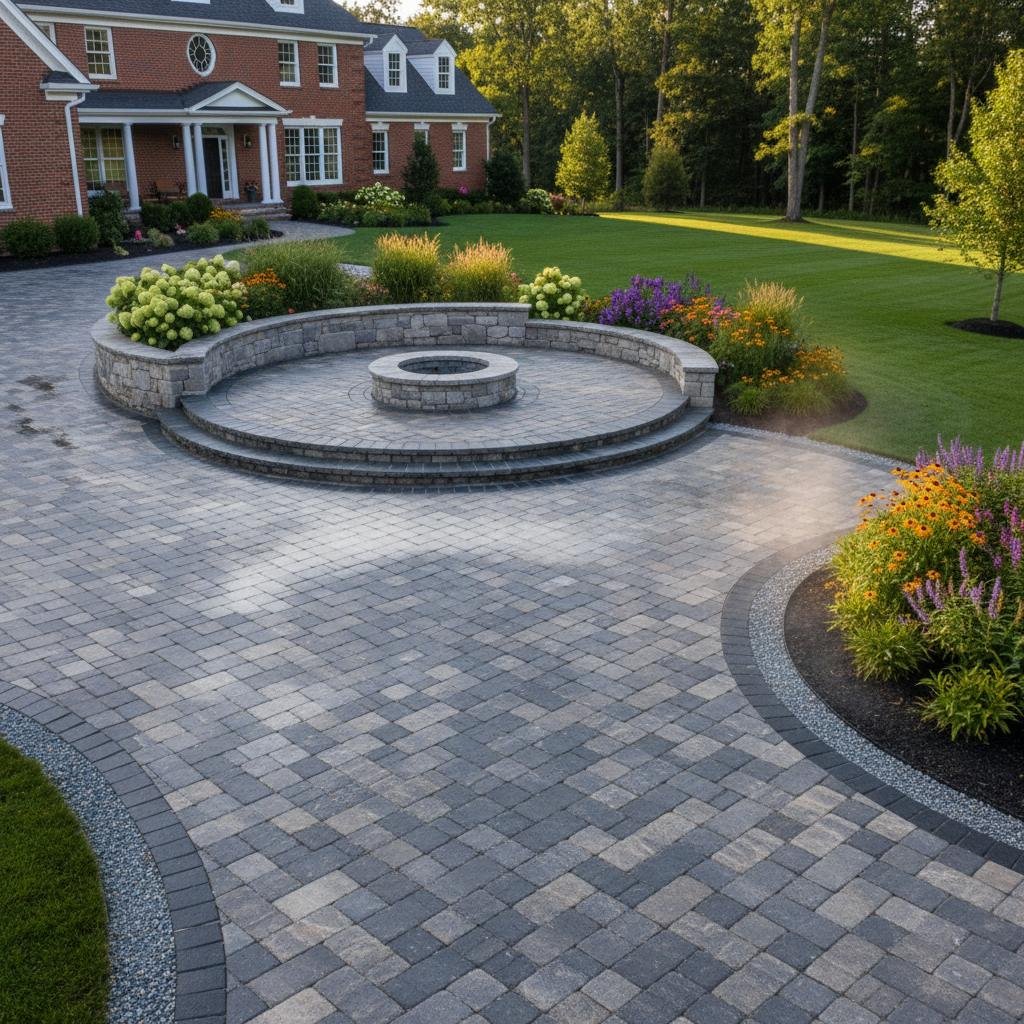
A poorly planned patio can worsen yard runoff by replacing absorbent ground with an impermeable slab. However, professionally installed patio pavers can actually resolve yard moisture problems when engineered correctly. By sloping pavers slightly toward drainage channels and setting them over an open-graded aggregate base, hardscaping surfaces shed rainwater directly into French drain systems or allow precipitation to filter cleanly into the subgrade without ponding.
4. French Drains and Deep Dry Wells
For low-lying spots where positive surface slope cannot be achieved naturally, subsurface drainage is essential. A French drain uses a trench lined with geotextile fabric, perforated pipe, and clean stone to intercept groundwater and carry it by gravity to a pop-up emitter, a dry well, or the street gutter where municipal codes allow. In areas like Clifton Park, where runoff frequently encounters dense underlying hardpan layers, handling Clifton Park water problems often relies on deep dry wells to store storm runoff temporarily while it percolates safely into deeper soil strata.
Case-Style Solutions: Capital Region Drainage in Practice
Scenario A: The Saturated Rotterdam Backyard
A Rotterdam homeowner with a split-level home had a backyard that stayed completely saturated for weeks after spring thaw. Downspouts emptied straight onto a flat lawn, and runoff from a neighboring property collected in a broad hollow right where the family wanted to entertain. To solve the problem permanently, the crew regraded the lawn to eliminate the central dip, installed a catch-basin network tied to a subsurface perforated pipe that collected neighbor runoff, and constructed a raised paver patio. The patio was built with an integrated trench drain along its perimeter, discharging runoff safely sixty feet away into a deep gravel dry well.
Scenario B: Hillside Seepage Along the Mohawk Ridge
On an elevated lot near the Schenectady-Niskayuna border, heavy seasonal runoff cascaded down a rear embankment, pushing mud against the home’s back entrance and threatening an aging timber wall. The fix called for excavating the failed embankment, installing a segmental concrete retaining wall backfilled with washed crushed stone, and tying dual four-inch drainage conduits directly into the hillside base. The retaining wall stabilized the yard, diverted gallons of subsurface groundwater around the foundation, and carved out a level upper terrace suitable for everyday outdoor living.
Transform Your Soggy Lawn into a Usable Outdoor Space
You do not have to surrender your property to seasonal mud, pooling water, or cracked pavers. Whether your home is located in Schenectady, Rotterdam, Niskayuna, Glenville, or Ballston Lake, our team pairs deep local knowledge of Capital Region soil conditions with proven hardscape engineering to deliver long-term results.
Ready to reclaim your lawn and safeguard your home’s foundation? Learn more about our comprehensive hardscaping and outdoor living services, or request a free site evaluation and quote today to get a customized drainage plan tailored to your property.