Planning an exterior upgrade starts with understanding the real investment involved. In Rensselaer County, the typical paver walkway cost Troy NY homeowners encounter ranges from $2,200 for a straightforward front entry path to upwards of $8,500 for a custom, winding path with integrated grade changes and landings. Across the river and down Route 4, a standard project typically falls between $22 and $38 per square foot installed, though site-specific conditions heavily influence the final number.
Whether you own a historic brownstone in downtown Troy, a sprawling colonial off Columbia Turnpike, or a split-level home in Wynantskill, walkway construction is not a one-size-fits-all job. Upstate New York soils, winter freeze-thaw cycles, and property slopes all play a direct role in what you will ultimately pay.
Average Paver Walkway Cost Troy NY Homeowners Can Expect
To help you budget accurately, it helps to look at average project scopes based on the size and purpose of the path:
- Short Entryway Path (3 to 4 feet wide, 20 to 25 feet long / ~75–100 sq. ft.): Best suited for direct connections from a driveway to a front stoop. Most homeowners spend between $2,000 and $3,500 for quality concrete pavers with a standard border.
- Long Meandering Front Walkway (120 to 200 sq. ft.): Often installed to replace cracked poured concrete leading from the curb to an entryway. Expect to budget between $3,200 and $6,500 depending on border cuts and curve radius.
- Side and Backyard Access Walkway (150 to 300+ sq. ft.): Connecting the front driveway around to an outdoor living space or pool area. These projects generally run between $4,000 and $9,000, especially if navigating slopes or tight lot lines.
When calculating your pathway pavers & bricks budget, keep in mind that the surface stone represents only about 20% to 30% of the project cost. The majority of your investment goes into excavation, gravel sub-base compaction, edge restraints, and precise labor that prevents shifting during frozen Capital Region winters.
What Drives Walkway Pricing in East Greenbush and Troy?
While square footage is the starting baseline, two paths of identical size can carry completely different price tags depending on physical site conditions and styling choices.
1. Excavation Depth and Freeze-Thaw Base Prep
The Capital District sits in USDA Plant Hardiness Zones 5b to 6a, meaning our frost line extends deep underground. A contractor who digs out only 3 or 4 inches of dirt will produce a walkway that heaves and cracks after a single winter. Professional installers excavate 8 to 10 inches deep, lay woven geotextile fabric to prevent subsoil migration, and build a compacted base using 6 to 8 inches of dense-graded crushed stone beneath a bedding layer of washed concrete sand. This labor and material commitment ensures durability but influences base excavation costs.
2. Soil Composition: River Flats vs. Sand Plains
Soil varies dramatically across our local communities:
- In downtown Troy, Watervliet, and low-lying sections of Cohoes, heavy urban clay and hidden demolition rubble from past eras slow down manual excavation.
- Out in West Sand Lake and sections of East Greenbush, sandy loam drains more readily but can shift if not contained with heavy-duty commercial edge restraints.
- Bedrock and shale shelves frequently show up along the ridges near RPI and Frear Park, requiring heavier excavation equipment.
3. Walkway Layout: Curves, Cuts, and Waste Factors
A straight rectangular path produces minimal material waste—usually around 5%. A curved walkway that flows organically through your lawn requires diamond-blade precision cutting on every outer and inner paver block. This increases labor hours and raises material waste to 10% or 15%, which directly nudges the overall East Greenbush walkway paver price upward.
4. Grade Changes, Slopes, and Step Integration
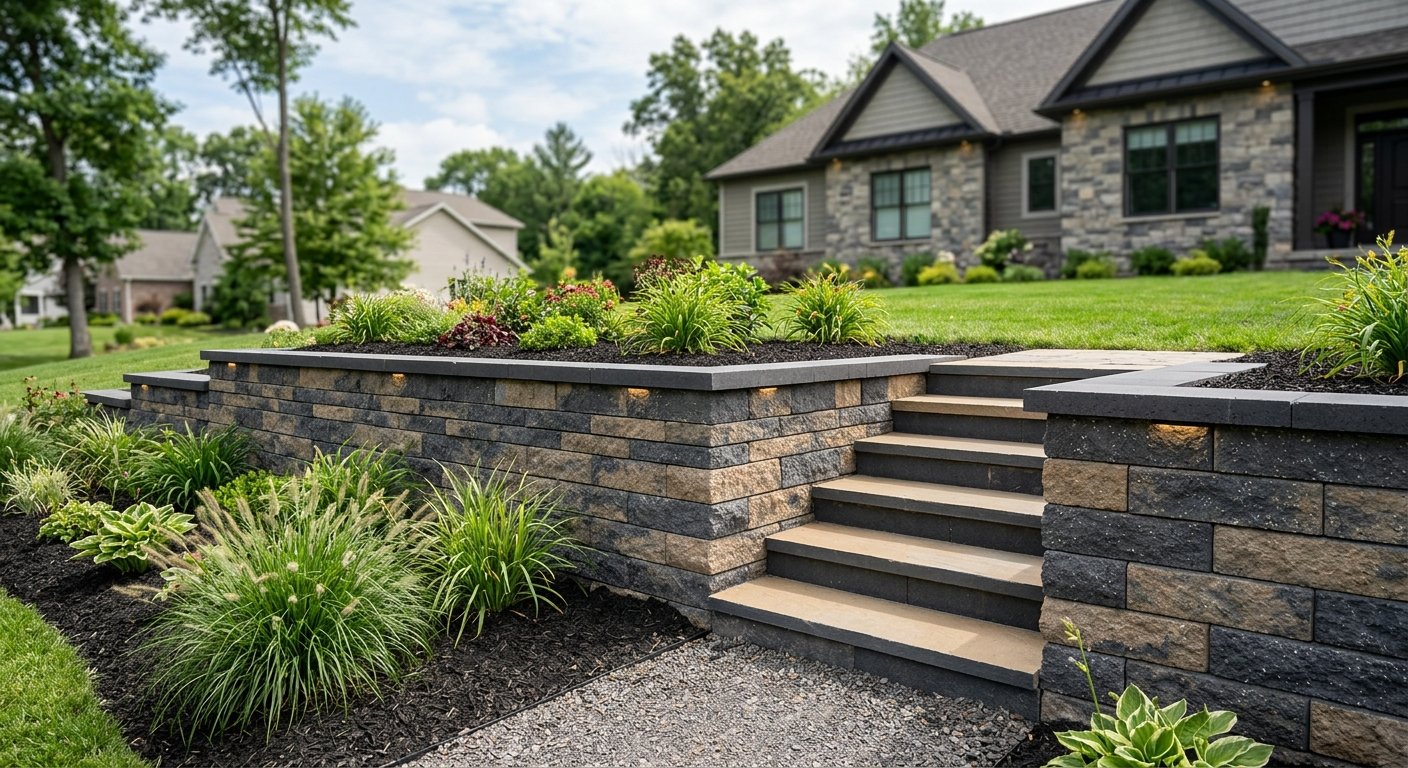
If your front lawn slopes down toward the street, a flat path will not work without reshaping the land. Installing block and stone steps or integrated timber/paver risers adds both safety and structural stability. Adding solid stone steps generally adds $350 to $750 per step riser, covering foundation base prep, structural adhesive, and leveling.
Design Ideas Tailored to Local Neighborhoods
Hardscaping should complement the age, architecture, and setting of your property. Here are a few regional design pairings that blend form and function:
Historic Troy & Watervliet: Classic Clay and Cobblestone Accents
Homes near Washington Park or 2nd Avenue carry Victorian, Federal, or Craftsman charm. Running-bond or herringbone patterns using clay-toned or tumble-finished concrete pavers echo historic municipal brickwork without the maintenance pitfalls of century-old pavers. Adding a dark charcoal or slate sailor-course border frames the path cleanly against vintage brick facades.
Suburban East Greenbush & Wynantskill: Natural Flagstone Textures
Ranch and contemporary colonial homes often feature broader front yards that benefit from wider, gently curved paths. Textured, multi-piece paver systems resembling natural bluestone provide an upscale look that softens front turf areas. For a cohesive upgrade, pairing your path with complementary patio pavers in the rear creates a unified hardscape identity across the entire parcel.
Cohoes Mill Lofts & Hillside Lots: Modern Linear Layouts
For a sleek look on modern or renovated hillside lots, large-format smooth pavers arranged in linear patterns offer crisp, uncluttered sightlines. Whether building a functional Cohoes backyard walkway to guide guests from a deck to a detached garage or revamping a compact Rensselaer front path squeezed between close residential lots, clean geometry makes smaller properties feel significantly more expansive.
Complementary Upgrades: Outdoor Lighting and Plantings
A walkway is more than a way to walk from point A to point B—it shapes how your home is viewed at dusk. Adding low-voltage landscape lighting transforms safety and curb appeal. Installing discreet path lights along curves or embedding brass flush-mount puck lights into paver borders typically adds $120 to $225 per fixture, including the central transformer and buried commercial-grade wiring.
Low-voltage systems prevent slip-and-fall hazards during dark winter evenings when invisible black ice can form along unsalted paths.
Pavers vs. Poured Concrete: The Long-Term Value Equation
Poured concrete initially costs less ($12 to $18 per square foot), but in our regional climate, standard concrete slabs almost inevitably develop hairline fractures caused by seasonal frost heave. Once concrete cracks, repairing it cleanly is impossible—the entire slab must be jackhammered out.
Paver systems, by contrast, are flexible pavements. The individual units shift microscopically with soil movements while the polymeric sand between joints prevents weed growth and washes out surface runoff. If a pipe needs servicing or a tree root lifts a section, pavers can be removed individually, the sub-base re-leveled, and the same blocks set right back in place without leaving a visual scar.
Get an Accurate Walkway Quote for Your Property
Online pricing ranges provide a helpful benchmark, but nothing replaces an in-person elevation check and site assessment. Eldi Pro Hardscaping builds beautiful, freeze-thaw-resistant walkways, welcoming patios, and custom outdoor lighting systems throughout Troy, East Greenbush, Rensselaer, Watervliet, Cohoes, Wynantskill, and West Sand Lake.
Ready to upgrade your home’s curb appeal with a durable, professionally built walkway? Contact our team for a free on-site estimate, and let us design a path built to last for decades.